Quantum physics final exam review
📘 The Knowledge System of Quantum Physics
🌅 Chapter 1: The Birth of Quantum Concepts
The Predicament of Classical Physics
- Blackbody radiation problem: classical theory predicts the ultraviolet catastrophe
- Wien’s displacement law:
- Stefan-Boltzmann law:
- Photoelectric effect problem: cannot be explained by classical wave theory
The Introduction of Quantum Concepts
- Planck’s quantization: , energy is quantized
- Einstein’s light quantum: , the particle nature of light
- de Broglie matter waves: , the wave nature of particles
Early Quantum Models
- Bohr model of the atom:
- Compton scattering:
🌊 Chapter 2: Wave Functions and the Schrödinger Equation
Introducing the Wave Function
- Wave-particle duality: particles have both wave-like and particle-like properties
- Definition of the wave function: expressed with the position vector r:
- Statistical interpretation (normalization): is the probability density of the particle at x
Properties of the Wave Function
- Normalization condition:
- Standard conditions: single-valued, finite, continuous, square-integrable
- Boundary conditions: and are continuous
- Uniqueness of the wave function: multiplying by a constant still describes the same physical state of the particle
The Schrödinger Equation
- Time-dependent equation:
- Stationary-state equation:
- Hamiltonian operator:
- Probability current density:
- Probability conservation equation: ,
- Role of the Schrödinger equation:
- Describes the time evolution of a quantum system
- Solving the equation yields the wave function (write down the stationary-state equation -> solve the differential equation -> determine the parameters from the properties)
- The square of the wave function gives the probability distribution of the particle’s position
🔧 Chapter 3: Operator Theory and Measurement
Introducing Operators
- Definition of operators: physical quantity → Hermitian operator (note: all operators in quantum mechanics are linear)
- Common operators:
- Position:
- Momentum:
- Energy (Hamiltonian):
- Hermitian operators:
- Defining equation:
- Or expressed as:
Eigenvalue Problems
- Eigenvalue equation: (analogous to eigenvectors and eigenvalues in linear algebra)
- Hermitian properties:
- Eigenvalues are real
- Eigenfunctions are orthogonal:
- (if m ≠ n)
- Eigenfunctions are complete: any wave function can be expanded in its eigenfunctions
State Expansion and Measurement
- State expansion:
- Expansion coefficients:
- Integral form:
, , cn is the projection coefficient of the wave function onto the eigenstate - Measurement postulate:
- The measurement result can only be an eigenvalue
- Measurement probability:
- Measurement average:
🎯 Chapter 4: Uncertainty and Commutation Relations
The Uncertainty Principle
- Heisenberg relation:
- Energy-time relation:
Commutation Relations
- Definition of the commutator:
- Fundamental commutation relation:
- Angular momentum commutation relations:
- (cyclic)
- Angular momentum eigenvalue equations:
- Commutation and measurement: commuting operators can be measured precisely at the same time
Complete Set Theory
- Definition of a complete set: the minimal set of commuting operators needed to completely determine a state
- Completeness condition:
📦 Chapter 5: Typical Quantum Systems
Potential Well Problems
Infinite potential well:
- Wave function: orthogonal
- Energy levels:
- E1 is the zero-point energy, i.e., the particle can never be completely at rest
Tunneling effect:
The Harmonic Oscillator
- Energy level formula:
- Zero-point energy: the ground-state energy is non-zero
The Hydrogen Atom
- Quantum numbers:
- Explicit differential form of the eigenvalue equation:
- Energy levels:
🌀 Chapter 6: Spin and Identical Particles
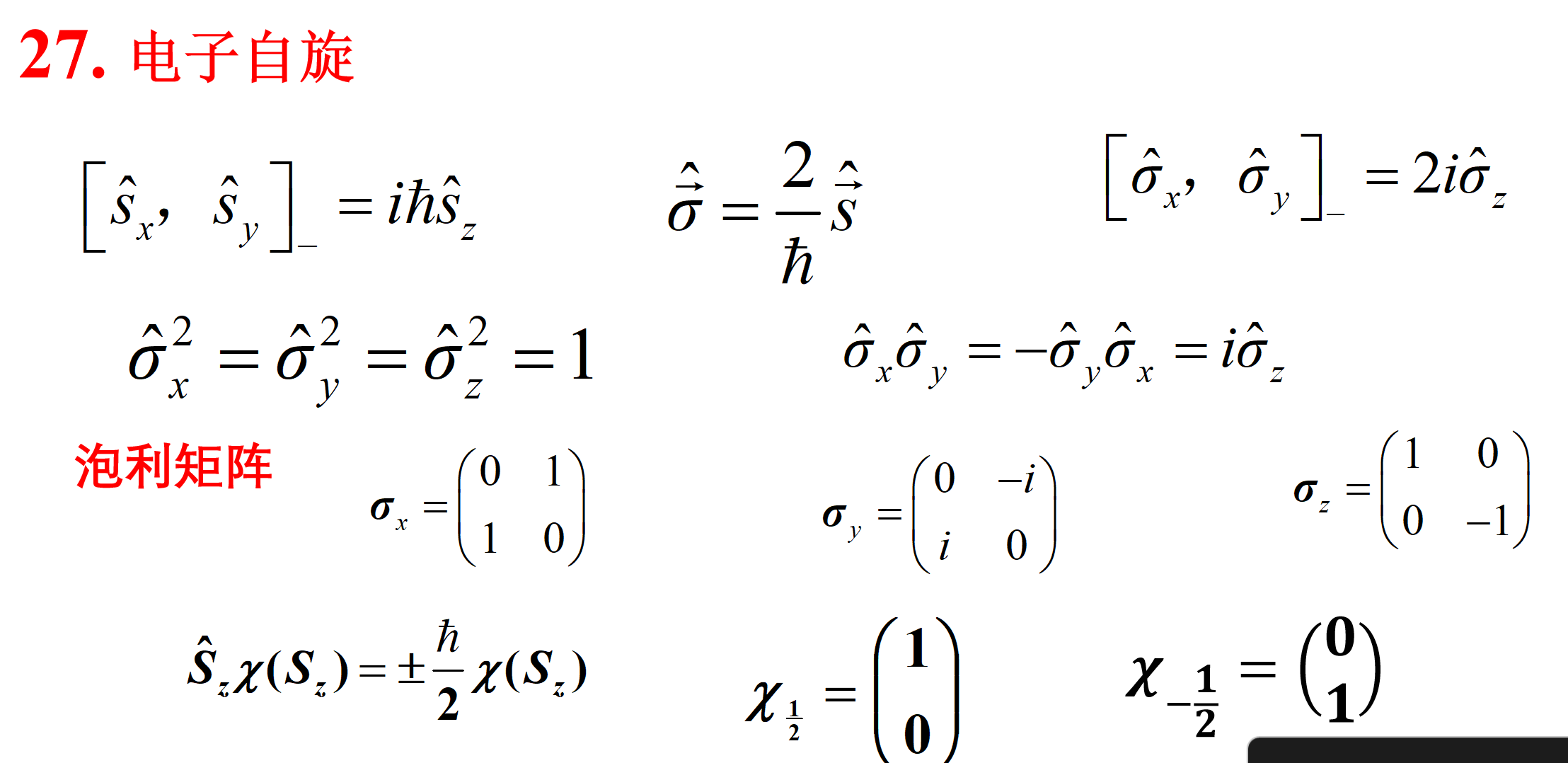
Electron Spin
- Spin operator:
- Pauli matrices: describe spin-1/2 systems
Statistics of Identical Particles
- Fermions: half-integer spin, antisymmetric wave function, obey the Pauli exclusion principle
- Bosons: integer spin, symmetric wave function, do not obey the Pauli exclusion principle
Two-State Systems
- Ammonia molecule model:
In the state space spanned by
Let
The corresponding energy eigenvalues are:
🎪 Summary of Core Ideas
The Basic Postulates of Quantum Mechanics
- State postulate: the wave function completely describes the quantum state
- Operator postulate: physical quantities correspond to Hermitian operators
- Measurement postulate: measurement outcomes are eigenvalues, with probability
- Evolution postulate: states evolve according to the Schrödinger equation
- Superposition postulate: any state can be written as a linear superposition of eigenstates
Characteristics of the Quantum World
- Wave-particle duality: both a wave and a particle
- Quantization: physical quantities take discrete values
- Probabilistic nature: measurement outcomes are probabilistic
- Uncertainty: not all physical quantities can be known precisely at the same time
- Superposition: a system can be in a superposition of multiple states
- Entanglement: quantum correlations exist between particles
Translated from the Chinese original.