An introduction to more advanced topics in graph theory.
Preface
Since I have already encountered the basics of graph theory many times in courses such as discrete mathematics, circuit theory, and algorithms, I will not repeat the basic concepts here and treat them as prerequisites. Only the extended material is covered.
Review of Basic Concepts
- In general, 𝛿(𝐺) denotes the minimum degree of graph 𝐺, and Δ(𝐺) denotes the maximum degree
- Induced subgraph: if 𝑉(𝐺) ⊆ 𝑉(𝐺′) and 𝐸(𝐺) ⊆ 𝐸(𝐺′), and moreover 𝐸(𝐺) = 𝐸 (𝐺′) ∩
, then 𝐺 is an induced subgraph of 𝐺′ - If in addition 𝑉(𝐺) = 𝑉(𝐺′), then 𝐺 is a spanning subgraph of 𝐺′
- If every vertex in the graph has the same constant degree 𝑟, the graph is called 𝑟-regular (r-regular graph)
- Simple graph: an undirected graph with no self-loops and no multiple edges is called a simple graph.
- Handshaking theorem (Leonhard Euler 1736): given an undirected graph 𝐺 = (𝑉, 𝐸),
- Corollary: in an undirected graph, the number of vertices of odd degree is always even
Graph: Isomorphism and Score
Graph isomorphism: if for a graph 𝐺= 𝑉, 𝐸 and a graph G’=(V’, E’) there exists a bijection
Counting Graphs
The number of graphs on 𝑛 vertices is
— each edge of the complete graph is either present or absent Any graph G=(V, E) is isomorphic to at most n! distinct graphs on V. From this we obtain the inequality
.
Graph Score
- Definition: the degree sequence
of a graph G is called the score of G. - Relation to graph isomorphism: isomorphic graphs necessarily have the same score. However, graphs with the same score are not necessarily isomorphic
- Existence: not every finite sequence can be the score of a graph. Whether a sequence is the score of some graph can be decided using the Score Theorem: let be a sequence of natural numbers with n>1 and , and let D’ be the sequence where . Then D is a graph score if and only if D’ is a graph score.
- Proof:
- if: add a vertex
to D’ to construct D - only if: D can be transformed into an isomorphic graph such that the last
vertices are connected to ; deleting these edges yields D’
- if: add a vertex
Applications of Handshake lemma
• Sperner’s lemma (Sperner, 1928): subdivide any n-dimensional simplex (𝑛-simplex) and color it with 𝑛+ 1 colors; then under any proper coloring scheme of the subdivided simplex, there must be a cell that contains all the distinct colors.
• Planar Brouwer’s fixed point theorem: Every continuous function
• Theorem (Smith): in a 3-regular graph, the number of Hamiltonian cycles containing any given edge 𝑒 is even.
Tree
Characterizations of Trees
- Tree-growing lemma: for a graph 𝐺 and a leaf 𝑣 of 𝐺, the following statements are equivalent
- G is a tree
- G - v is a tree
- Equivalent characterizations of a tree:
- II. Unique paths: for any two vertices u ,
, there exists a unique path from u to v. - III. Minimal connected graph: G is connected, and removing any single edge makes it disconnected.
- IV. Maximal acyclic graph: G contains no cycle, but adding any single edge yields a graph G+e (where
) that contains a cycle.
- IV. Maximal acyclic graph: G contains no cycle, but adding any single edge yields a graph G+e (where
- V. Euler’s formula: G is connected and |V|=|E|+1
- II. Unique paths: for any two vertices u ,
Counting Trees
Two trees 𝑇, 𝑇′ are “equal” if and only if the edge set of tree 𝑇 equals the edge set of tree 𝑇′.
Cayley’s Theorem
(Cayley’s formula): there are
- Core proposition: let
be positive integers whose sum is . Then in the graph (the complete graph, in which every pair of the vertices is joined by an edge), the number of spanning trees in which vertex has degree exactly ( ) equals - Proof
- Base case: for n = 1, 2 the proposition clearly holds. When n = 1 the graph has only one vertex, which can be regarded as a degenerate tree; when n = 2 there is a single edge joining the two vertices, so there is only one tree shape, which agrees with the formula above.
- Inductive step (n > 2): since , by the handshaking theorem there must exist some i with ; without loss of generality let . For , define to be the set of spanning trees of that contain the edge . From each tree in , delete the vertex to obtain ; is a spanning tree of whose vertex degrees are
- By the induction hypothesis, we obtain , which can be rewritten as
- Since , after a series of algebraic manipulations, we sum over all tuples satisfying and , i.e. over all such , giving Let ; then and , and the expression becomes , which by the multinomial theorem equals . This proves that the number of distinct trees on n vertices is .
Tree Isomorphism
Rooted Tree Isomorphism
Definition: 𝑇, 𝑟 ≅′ (𝑇′, 𝑟′):
- 𝑓: 𝑉(𝑇) → 𝑉(𝑇′) is an isomorphism 𝑇 ≅ 𝑇′,
- 𝑓(𝑟) = 𝑟′
- The relation ≅′ is strictly stronger than the relation ≅.
Using an encoding, one proves that if and only if they have the same encoding.
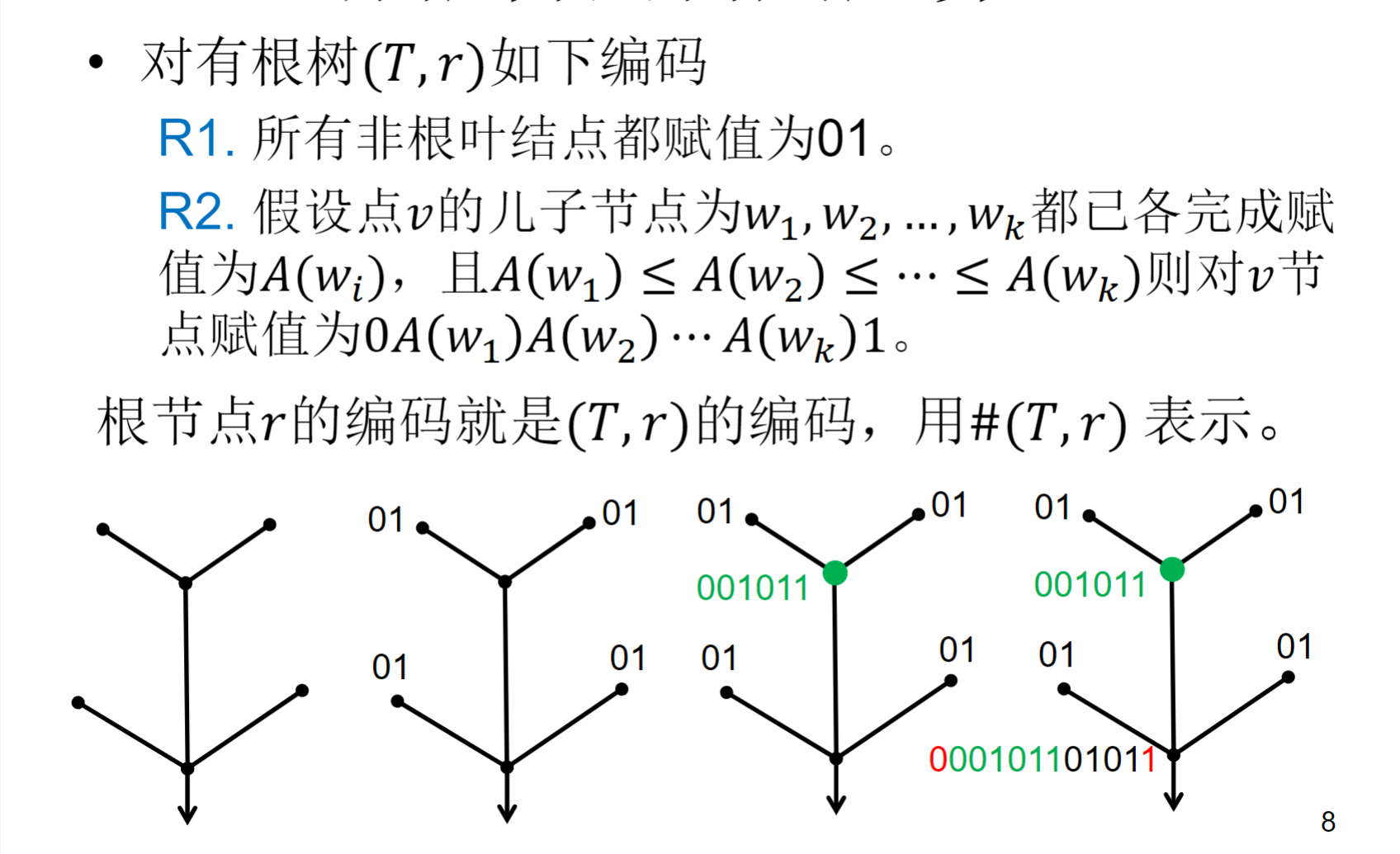
Proof:
– Sufficiency: follows from the definition of rooted tree isomorphism and the encoding.
– Necessity: decode, i.e., recover the original tree structure from the encoding.
The encoding of any rooted tree necessarily has the general form 0𝑆1, where
𝑆1 is the shortest prefix of 𝑆 with equal numbers of 0s and 1s, 𝑆2 is the second shortest 0/1-balanced prefix, and so on.
The rooted tree can be recovered from this, and clearly such rooted trees must be isomorphic.
Unrooted Tree Isomorphism
Problem reduction: general tree isomorphism ⊑ rooted tree isomorphism
• Distance: for two vertices u ,v in a graph G, disc(1,1) denotes the length of the shortest path between 𝑢, 𝑣.
• Eccentricity: for a graph 𝐺 and a vertex 𝑣 in it, the eccentricity is defined as:
• Center: the set of vertices of graph 𝐺 with the minimum eccentricity is called the center, denoted by 𝐶(𝐺).
Property: for a tree 𝑇 = (𝑉, 𝐸), 𝐶(𝑇) contains at most 2 vertices. Moreover, if 𝐶(𝑇) = 𝑥, 𝑦 , then 𝑥, 𝑦 ∈ 𝐸
If 𝐶(𝑇) contains only a single vertex 𝑣: output the encoding #(𝑻, 𝒗) of the rooted tree (𝑇, 𝑣).
• 𝐶(T) = {𝑥1, 𝑥2}: let 𝑒 = {𝑥1, 𝑥2}
𝑇 − 𝑒: has exactly two connected components 𝑇1, 𝑇2. Without loss of generality let 𝑥1 ∈ 𝑉(𝑇1), 𝑥2 ∈ 𝑉(𝑇2).
- Compute #(𝑇1, 𝑥1) and #(𝑇2, 𝑥2)
- If #(𝑇1, 𝑥1) ≤ #(𝑇2, 𝑥2), output #(𝑻, 𝒙𝟏)
- Otherwise, output # (𝑻, 𝒙𝟐)
The proof then proceeds as for the rooted tree encoding.
Translated from the Chinese original.