Overview
Process is a program in execution.
Basics
Concept
- sequential not parallel
Process vs Program
- Program becomes process when an executable file is loaded into memory
| Aspect | Program | Process |
|---|---|---|
| Definition | A static set of instructions stored in secondary storage (e.g. a hard disk); a passive entity | A dynamic instance of a program in execution; an actively running entity |
| Attributes | Only a static description of instructions and data | Includes runtime state such as the program counter, memory state, and register values |
| Lifetime | Long-lived (unless deleted) | Transient (from creation to termination) |
| Resource needs | Occupies no system resources (only disk space for storage) | Needs CPU time, memory, I/O devices, and other resources |
| Control structure | No control block | Has a process control block (PCB) recording its running state and resource allocation |
Memory
- Stack: local variables, function parameters, return address
- Heap: dynamic memory allocation
- Data: global variables fixed
- Text: code fixed
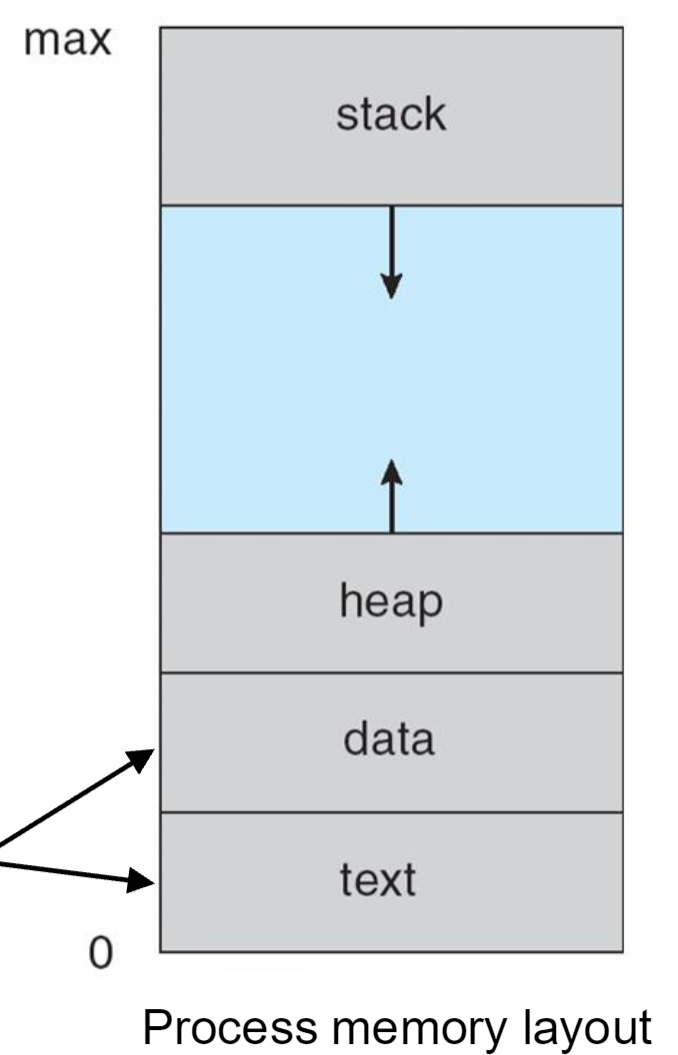
Current Process are recorded in PCB
- Program Counter
- Processor Registers
Process State
- New: The process is being created
- Ready: The process is waiting to be assigned to a processor
- Running: Instructions are being executed
- Waiting: The process is waiting for some event to occur
- Terminated: The process has finished execution
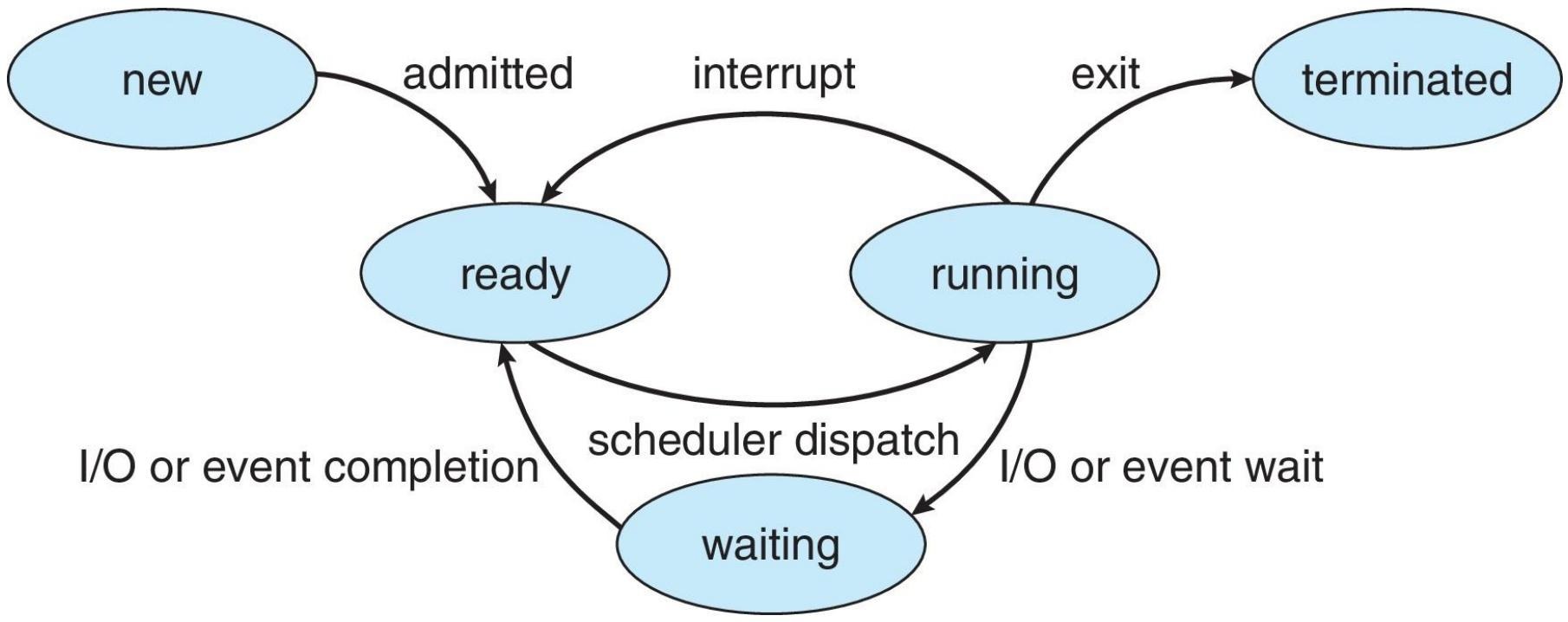
Process Control Block (PCB)
- Process ID
- Process State
- Program Counter
- CPU Registers
- Process Memory Address
- CPU Scheduling Information
- Accounting Information
- I/O Status Information
Scheduling
Process scheduler selects among available processes for next execution on CPU core.
Maintains scheduling queues of processes:
- Ready queue
- Wait queue
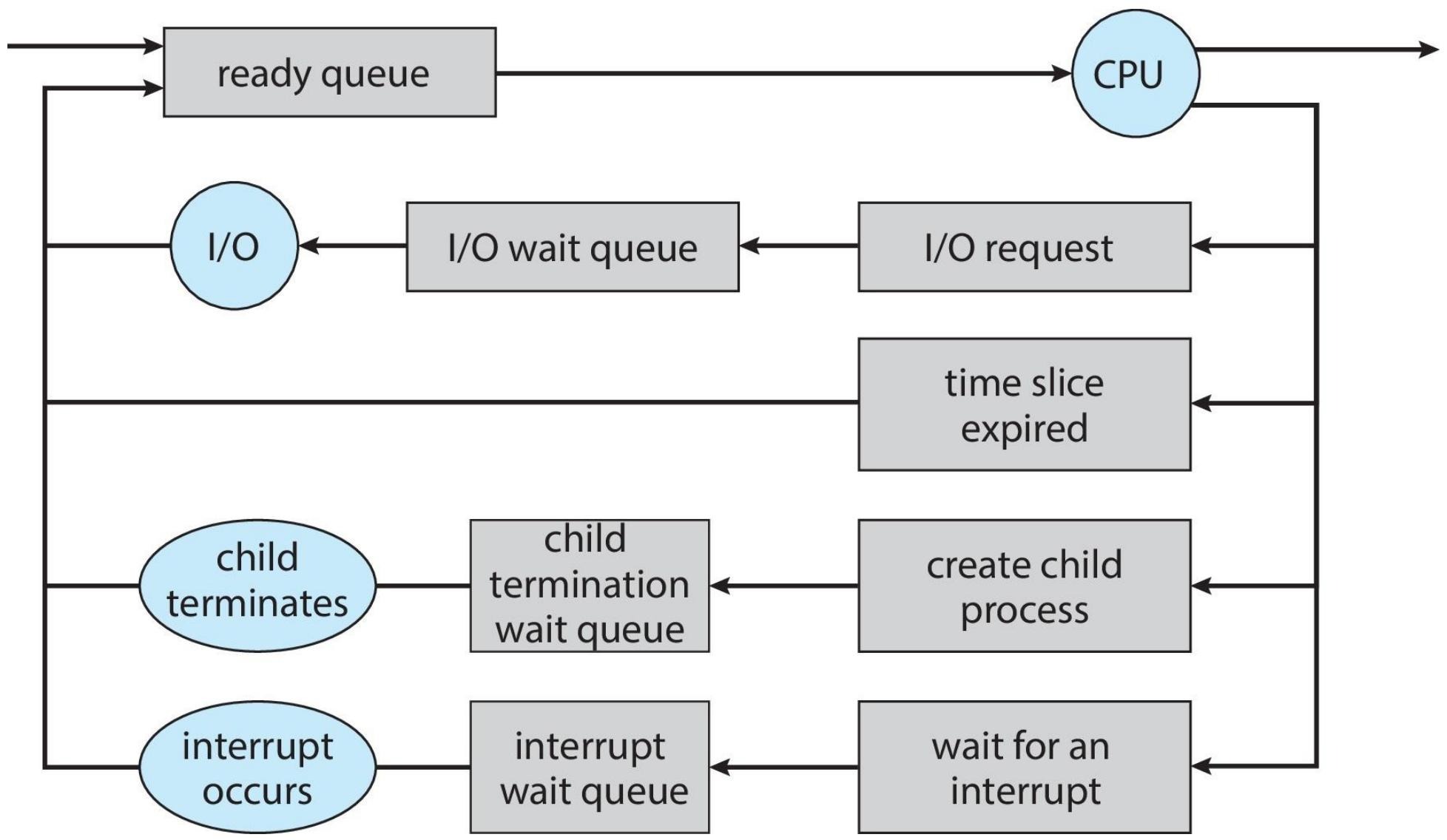
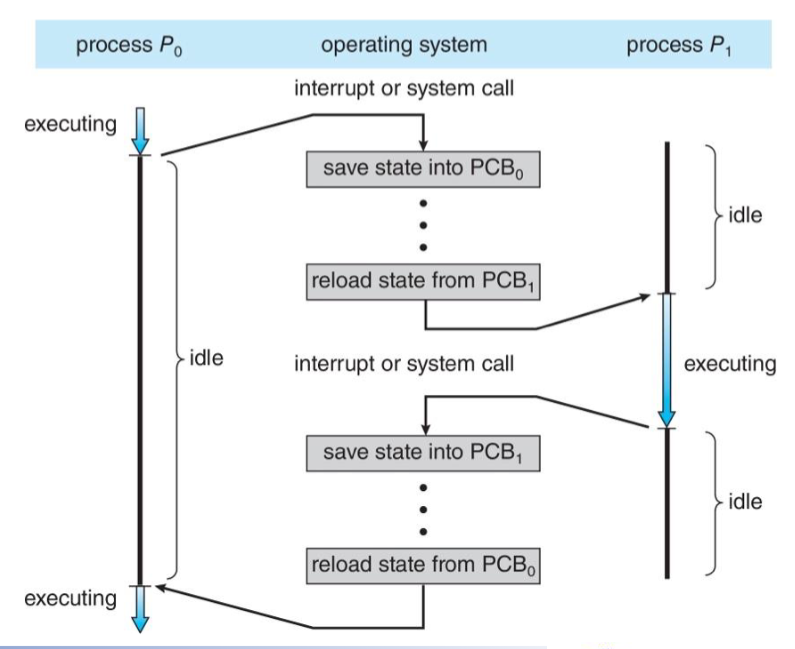
Context switch
- Save current process state
- Load next process state
- Switch to the next process
The switch time is pure overhead, and depends on the hardware (number of registers)
Scheduler
- Long-term scheduler: selects processes (which ones get admitted to the ready queue); slow
- Short-term scheduler: CPU scheduling (which process runs next); provides concurrency; fast
Operations
Process Creation
- A parent process creates child processes (forming a tree)
- resource sharing
- execution : concurrent / the parent waits for the child to terminate
- address space: duplicate with fork() / load a new program with exec()
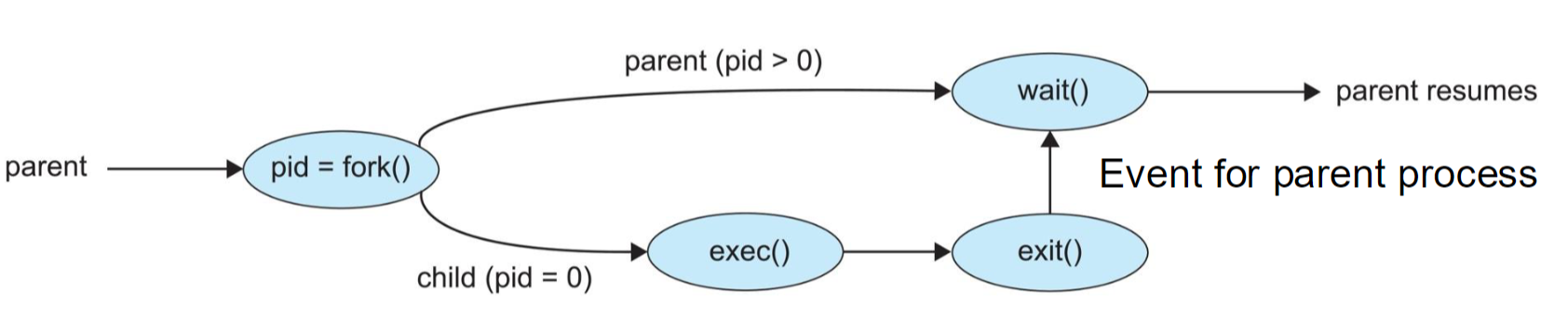
When a process calls fork(), the child starts executing from the statement right after the one the parent last executed.
e.g. three fork() calls produce 8 processes.
Process Termination
- The child terminates (exit)
- The parent reclaims the child’s resources (via wait())
- abort(): cascading termination
- Orphan process: the parent terminates while the child keeps running
- Zombie process: the child has terminated but the parent has not reclaimed its resources
- Solution for orphan and zombie processes: the init process (pid=1)
Interprocess Communication
| Aspect | Shared memory | Message passing |
|---|---|---|
| Core idea | Shared memory, direct reads and writes | Messages relayed through the kernel, indirect communication |
| Speed | Fast | Slow |
| Complexity | High (needs synchronization) | Low (abstracted by the system) |
| Suited to | Single machine, high frequency, tight coupling | Distributed, loose coupling |
| Synchronization | Explicit (e.g. mutexes, semaphores) | Implicit (e.g. message queues) |
| Scalability | Poor (limited by memory size) | Good (scales to distributed systems) |
Shared Memory
Producer process produces information that is consumed by a consumer process
- Unbounded buffer
- Bounded buffer
Message Passing
Direct Communication
Explicit naming
Communication link: must be explicitly established and closed
Example:
Process A calls send(B, “Hello”) to send a message directly to process B.
Process B receives the message from A via receive(A, msg).
Indirect Communication
Messages are directed to and received from mailboxes (also referred to as ports)
- Each mailbox has a unique ID
- Processes can communicate only if they share a mailbox
Synchronous
- Blocking
- The sender blocks until the receiver is ready and the message has been received
- The receiver blocks until a message is received
- Non-blocking
Pipe
A pipe is a half-duplex communication channel that lets the output of one process serve directly as the input of another.
In essence it is a pseudo-file implemented on top of a kernel buffer.
Require parent-child relationship.
Ordinary Pipe / Anonymous Pipe
Data can only flow from the write end of the pipe to the read end; it is unidirectional.
The communicating processes must have a parent-child relationship and be on the same machine.
Named Pipe
Communication is bidirectional.
No parent-child relationship
Communication in Client-Server Systems
Socket
An IP address uniquely identifies a device on the network, while a port number distinguishes the different network services on the same device and locates the specific process.
Create a socket:
- Server side
- bind()
- listen()
- accept()
- read() / write()
- close()
- Client side
- connect()
- read() / write()
- close()
Every connection has a unique pair of sockets; processes can only exchange plain byte streams and cannot forward structured packets to each other.
Remote Procedure Call
RPC is a communication protocol for distributed computing that allows one process to call a function in another process.
RPC turns a local function call into a remote function call by communicating over the network.
- Local call:
- Call the local function
- Return the result
Translated from the Chinese original.